
It's Philosophy, Stupid
on psychology and destructivist politics

The Renaissance is usually told as a story about technique. The recovery of perspective. The rediscovery of anatomy. Brunelleschi’s dome. Other times it’s a story of science. Leonardo’s notebooks. The republic of letters. Copernicus, etc. And all of that happened, but it was a symptom. The cause was philosophical.
What happened was that enough people, after a thousand years of being told that the universe was incomprehensible to them, that truth was revealed, and that their individual lives were secondary to the divine, began to insist otherwise. They started reading, writing, and they started to see that their mind could understand the world.
It wasn’t a minor adjustment. It was the most radical revolution in history, and its implications took centuries to fully unfold.
If the human mind can apprehend reality, if reason is a reliable tool — then you don’t really need a priest to reveal truth to you. You don’t need a king to organise your existence. You don’t need a pope to mediate between you and the world.
If the mind is an individual's primary tool for survival, it cannot function under coercion. You cannot force someone to genuinely think or to make moral choices at gunpoint. Therefore, for a rational being to live as a rational being, they require a sphere of autonomy—freedom from initiated violence. That sphere of autonomy is what we call "rights".
It’s the one thing that Immanuel Kant and Ayn Rand actually agree on, so you know there’s something to it. You need rights. You need liberty. You need a political system that treats the individual as sovereign.
For roughly two hundred years, this idea — the sovereign individual, equipped with reason, entitled to liberty — was the animating premise of Western civilisation. It produced science, capitalism, constitutional government, the abolition of slavery, the expansion of rights, and the longest sustained increase in human flourishing in the history of the species. Its crown jewel was the American constitution. It was incomplete and unevenly applied. It was, in many ways, a promissory note that took generations to begin honouring. But the premise was clear: your life is yours.
Kant began the downfall — or rather, Kant cracked open the door through which others would walk. His argument was subtle but enormously influential: the mind does not passively receive reality. It structures reality. What you perceive is not the world as it is but the world as your cognitive machinery constructs it. The thing-in-itself is forever inaccessible. Basically, Plato’s cave, but make it harder to read.
That sounds innocent enough, and in Kant’s hands it was. But what if different minds — or different groups, or different cultures, or different positions in a hierarchy — see reality differently? Then there is no single truth. There is no objective reality. There are only perspectives, and which one wins is determined not by reason but by power.
Foucault. Derrida. Marcuse. The critical theorists. Their project — and it was a project, deliberate and systematic — was the dismantling of the Enlightenment premise. Reason is not a tool of knowledge, they argued. It is a tool of power. Truth is not discovered. It is constructed by those with the authority to enforce their construction. The individual mind is not sovereign. It is a product of discourse, of power structures, of the group it belongs to. Your “knowledge” is just your group’s perspective dressed up in the costume of objectivity.
The implications were totalising. If reason can’t access truth, then the individual has no ground to stand on. If knowledge is a function of group position, then individual judgment is an illusion. If truth is power, then argument is pointless — the only thing that matters is who controls the institutions that get to define what counts as true.
These ideas flooded Western universities beginning in the 1970s. By the 1990s they were in the water. By the 2010s they had produced a generation — then two generations — trained in a philosophical framework that did something very specific to their narrative identity: it removed them from the driver’s seat.
The postmodern professor occupied the same structural position as the medieval priest. Both said the same thing: you cannot figure this out yourself. You need us. I don’t mean that any of these students could explain Kant, or Marcuse, or Plato for that matter. Very often, they have no idea whose ideas they’ve absorbed.
Without much of a struggle, the individual had been philosophically dismantled. And the people walking out of these institutions carried that inside them like a fracture.
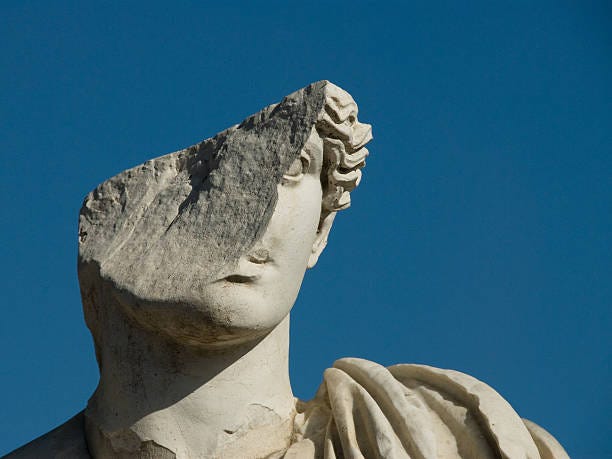
What happens when you de-moralise a generation?
The philosophy didn't travel as philosophy. It traveled as a feeling. You don't need to have read Foucault to have absorbed his conclusion. A generation raised in institutions saturated with these ideas didn't emerge as postmodern theorists — they emerged with a background hum of illegitimacy. If your perception is shaped by your position, if institutions are seats of power, not values, if your reason is just violence in disguise — then trusting yourself becomes an act of bad faith. The psychological result is not just skepticism. It's vulnerability. A person who has been quietly trained to distrust their own mind is extraordinarily open to anyone offering a ready-made story about who they are and what they owe.
The psychological literature is precise about this. When the coherent self-story breaks — when agency collapses and a person loses the sense of being an author shaping their own plot — the result is a predictable hunger for a story to inhabit. A collective narrative with clear heroes and clear villains, a grand drama that absorbs the fragmented self, and a martyr or saint — someone to carry the burden of meaning on your behalf.
Wokeism was that story.
It had everything. A cosmic drama: structural injustice permeating everyday life. A priesthood of academics and activists who could tell you where you stood in the moral hierarchy. And a role for you, an easy way to matter: penance. Either way, you were absorbed into a story larger than yourself. This made you feel good.
And for a while, that did the job.
But here’s what the psychology also predicts: the penance was never going to be enough.
Because the hunger that drove people to wokeism was not political. It was existential. It was the hunger of the nihilist self for a story — for meaning — that would fill the void. The movement could not fill the void for the simple fact that it was a placebo. An attempt to assert truth through power. The march ends. The black square falls further down the instagram feed. Human nature kicks back in. And nothing had changed.
Tyler Cowen predicted in 2022 that wokeism had peaked, and he was right. DEI retreated. Universities got cautious. Donald Trump won the election. But Cowen returned this year with an ominous addendum: the energy hadn’t dissipated. It had mutated. The unreasonable side of wokeism — the appetite for power — had remained but the mask had slipped.
John Aziz, writing in Quillette last week, gave it a name. He calls it destructivism: the conviction that the most necessary political act is no longer reform, redistribution, or even the policing of language — but demolition. The pure desire to tear down systems deemed oppressive, with no programme for what replaces them. Take the billionaires’ money, not to fund something, but because they have it. Tear down Israel, not to build Palestine, but because Israel is a structure and structures are oppression. Abolish, dismantle, defund — the verbs of a movement that has lost interest in the pretence of pronouns. Aziz describes the symptom precisely.
What he doesn’t explain — what symptom-level analysis can’t explain — is why the energy went here and nowhere else. The answer, I think, is that it it was there to begin with. The point was always penance, and destruction is the ultimate sacrifice.
The philosophical premises — the denial of objective truth, the assignment of worth to group membership, the elevation of sacrifice over creation — my truth, my voice — were always going to resolve here, because destruction was always the point. It's what unites the omnicause: the left's rotating portfolio of grievances, from environmentalism to woke to free Palestine. Nuclear power and two-state solutions are an inconvenience. The destruction is the point.
So here’s what the psychology predicts.
The hunger that produced wokeism, and that is now producing destructivism, does not dissipate when you feed it destruction either. Destruction delivers the sense of mattering the way a drug delivers relief: with an escalating dose.
This means the targets must grow. A philosophy built on the denial of individual achievement will inevitably expand its definition of what counts as oppressive — because any visible achievement implies an individual who acted and who shaped the world according to their own values.
This is exactly what we are told we cannot do. Achievement is proof that agency works. Agency working is an existential threat to nihilism. So achievement itself must become the villain. In practice, this means attacking the capacity for production itself. Not just billionaires but wealth creation. Not just inequality but growth.
This isn’t theoretical. The Routledge Handbook on Degrowth was published last year — not by a fringe press, but by one of the world’s largest academic publishers, with fifty-five contributors across thirty-five chapters. Its title is not subtle: “Degrowth Has Come of Age”. A survey of the movement’s own members, published in Energy Research & Social Science, found overwhelming consensus that “profit-making is a form of violence” and that redistribution must come through struggle, not reform.
The tenth International Degrowth Conference took place last year. The eleventh opens this week in Krakow. These are not marginal gatherings. They are the institutional expression of a philosophy arriving at its logical conclusion. This is envy. And the students marching to tax the trillionaires are not marching for anything. Ask them what they’d build with the money. The question doesn’t occur to them.
The targets will also turn inward. A movement built on collective identity cannot tolerate individual distinction, because distinction implies agency, and agency is the heresy. Any member who stands out — too competent, too articulate, too visibly someone — becomes a threat to the collective premise.
Last year, the progressive organising group Our Revolution surveyed its members and found that ninety percent wanted Senate Minority Leader Chuck Schumer to step aside — not a Republican, their own leader. Seventy percent wanted Hakeem Jeffries gone. A twenty-seven-year-old Democratic Socialist filed to primary Jeffries for his Brooklyn seat, backed by a faction that considers the Democratic leadership insufficiently committed to the cause. Even Alexandria Ocasio-Cortez distanced herself from the challenge — which tells you something about where the movement’s purity threshold now sits when AOC is the moderate.
And here is the twist: the right is running the same programme. The right is reactive, and always has been, and in fighting the left has accepted the same philosophical frame.
Elon Musk said DOGE needed to “delete entire agencies”. Not reform, destruction. “If we don’t remove the roots of the weed, it’s easy for the weed to grow back.” Russell Vought, the architect of Project 2025, told his staff: “We’re going to let DOGE break things, and we’ll pick up the pieces later.”
There is a word for this, and the word is not polarisation. Polarisation implies two poles and a recoverable centre. Bloomberg liberalism is no longer the geometric mean.
The word is anomie.